
Those Black Streaks on Your Roof Aren't Damage — Here's What They Really Are
We get this call a lot.
A homeowner in Frederick or Gaithersburg notices black streaks on their roof and immediately assumes the worst — cracked shingles, water damage, maybe even a full replacement. They start mentally calculating the cost of a roof replacement.
Then we take a look and tell them the good news: your roof is probably fine. Those streaks are algae, and we can remove them.
Here's everything you need to know.
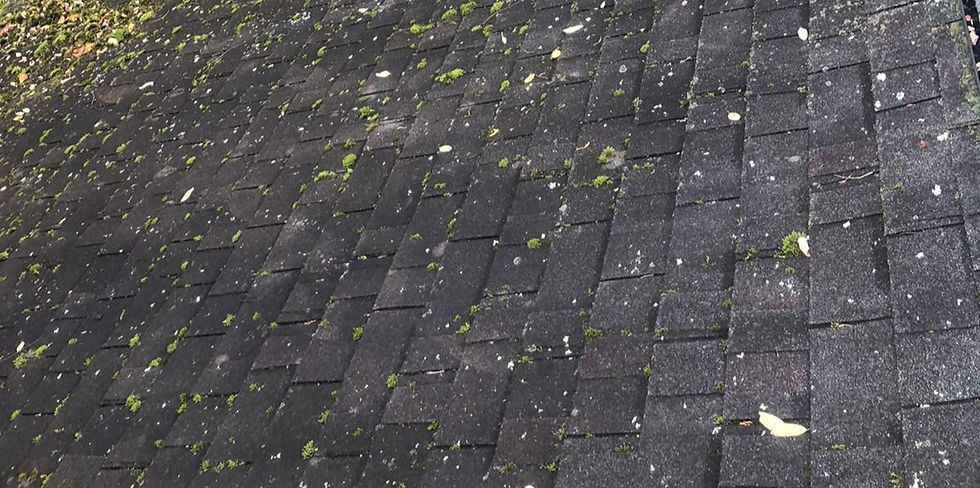
What Are Those Black Streaks on My Roof?
The dark discoloration you're seeing is almost always caused by a type of blue-green algae called Gloeocapsa Magma. It's spread through the air via microscopic spores that land on your roof, find moisture and organic debris, and start to grow.
As the algae colony expands and dies, it leaves behind a dark, protective outer coating — which is the black or dark gray streaking you see running down your shingles. Over time, without treatment, it spreads across larger and larger sections of your roof.
You are not alone in this. It's extremely common across Maryland, Virginia, and the entire Mid-Atlantic region — our humid climate is practically a welcome mat for Gloeocapsa Magma.
Why Does It Show Up on Some Parts of the Roof and Not Others?
Algae thrives in shade and moisture. That's why you'll usually see it first on:
North-facing roof sections that get less direct sunlight
Areas under or near large trees where shade and leaf debris accumulate
Lower sections of the roofline where moisture lingers longer
If your neighbor's roof looks clean and yours doesn't, it's likely just a difference in sun exposure or surrounding tree coverage — not a sign that your shingles are lower quality.
Is It Damaging My Roof?
In the short term, no. But left untreated for years, Gloeocapsa Magma can:
Reduce your roof's reflectivity, causing your home to absorb more heat and increasing cooling costs in summer
Attract and retain moisture, which accelerates granule loss on asphalt shingles over time
Create conditions for moss and lichen to follow — those are harder to remove and do cause more direct physical damage to shingles
So while black streaks on your Frederick MD roof aren't an emergency, ignoring them for years does create real problems down the line. Treating it now is much simpler and cheaper than dealing with the consequences of years of unchecked growth.
What About Moss and Lichen — Are Those Different?
Yes, and they're worth knowing about:
Algae (like Gloeocapsa Magma) is the dark streaking. It's the most common and the easiest to treat.
Moss is the green, fuzzy growth that builds up — especially in corners and along the north side of a roof. It holds moisture against your shingles and can lift the edges over time.
Lichen is a combination of algae and fungus that bonds directly to the shingle surface. It's harder to remove and can leave behind staining even after treatment.
All three respond well to professional soft washing, though lichen sometimes requires follow-up treatment for complete removal.
Can I Remove It Myself?
You'll find plenty of advice online suggesting DIY roof cleaning with bleach solutions. We want to be honest with you: it's possible to remove algae yourself, but there are real risks involved.
Using too much pressure — even with a standard garden hose on a ladder — can loosen shingle granules and void your manufacturer's warranty. Getting the chemical mixture wrong can damage surrounding plant material. And working on a wet, steep roof is genuinely dangerous.
Professional soft washing is specifically designed for roofs. We use:
Very low pressure (well under 500 PSI) — fully compliant with ARMA roofing guidelines and safe for all shingle types
Biodegradable cleaning solutions that kill the algae at the root, not just on the surface
Pre-treatment of surrounding plants to protect your landscaping
Proper safety equipment and training for roof work
The results last 2–4 years. A DIY surface rinse might look okay for a few weeks before the algae returns.
Will Soft Washing Void My Roof Warranty?
No. Our soft wash method operates at a fraction of the PSI used in pressure washing and is fully compliant with ARMA (Asphalt Roofing Manufacturers Association) guidelines. Manufacturer warranties are not voided by low-pressure soft washing — in fact, many manufacturers recommend it over pressure washing.
If you have a specific warranty concern, we're happy to review it with you before we start.
What Does Roof Soft Washing Cost?
Pricing depends on the size of your roof, its pitch, accessibility, and the extent of the algae growth. We provide free, no-obligation quotes for every job. Most homeowners are genuinely surprised at how affordable it is compared to what they'd imagined — especially when you factor in that results last several years.
We also offer package pricing when you combine roof soft washing with gutter cleaning or house siding washing on the same visit.
Don't Let Algae Mislead You
The dark streaks on your roof are not a sign of failure. They're a sign of the normal Maryland climate doing what it does. The fix is straightforward, affordable, and — with professional soft washing — long-lasting.
If you're seeing streaks on your roof in Frederick, Gaithersburg, Germantown, Clarksburg, Damascus, or anywhere in between, give us a call. Juliana will take a look and give you an honest assessment — no pressure, no upsell.
Pro Washing Services is a licensed, insured, family-owned exterior cleaning company serving Frederick County, MD and surrounding areas including Gaithersburg, Germantown, Damascus, Ballenger Creek, and Clarksburg.


Comments